
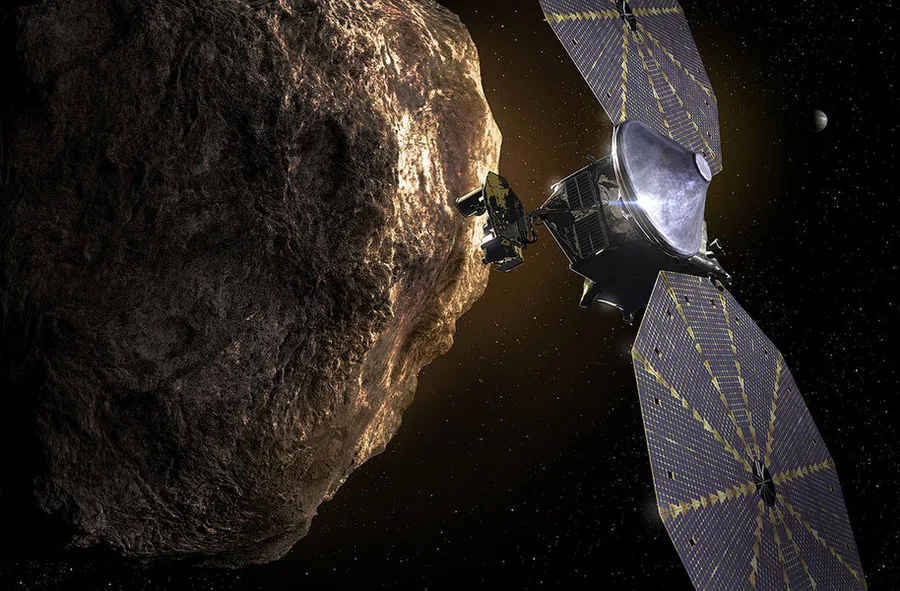
U.S. Launches New Space Mission to Study Asteroids
In an exciting new development for space exploration, NASA has launched a groundbreaking mission designed to study asteroids that could hold critical information about the origins of life and the early solar system. The mission, named AstroProbe, aims to collect and analyze samples from several asteroids, offering researchers a unique opportunity to investigate these celestial objects up close.
Asteroids, often referred to as the “building blocks” of the solar system, are remnants from its formation billions of years ago. Scientists believe that by studying the composition of asteroids, they can unlock secrets about the conditions that existed in the early solar system and gain insights into the materials that may have contributed to the formation of life on Earth. The new mission, which launched from Kennedy Space Center earlier this week, is expected to provide groundbreaking data that could enhance our understanding of the universe and our place in it.
The AstroProbe spacecraft is equipped with state-of-the-art instruments designed to analyze the composition, surface properties, and chemical makeup of the targeted asteroids. The mission will visit multiple asteroids, including one of the largest near-Earth asteroids, Pallas, which is thought to be a remnant of the early solar system that never coalesced into a full-fledged planet. By examining such objects, NASA scientists hope to learn more about the fundamental building blocks of planetary formation and the conditions that led to the emergence of life.
One of the key goals of the mission is to determine whether asteroids could have played a role in delivering water and organic molecules to Earth in its early history. This theory, known as panspermia, suggests that life on our planet may have originated from these extraterrestrial materials. By analyzing asteroid samples, scientists hope to gather evidence that could support or challenge this idea.
The spacecraft will also study the impact of asteroid collisions, which have shaped not only the solar system but also Earth’s own geological history. These impacts have had significant effects on the development of life on Earth, with some scientists believing that asteroid collisions may have triggered mass extinctions or even influenced the course of evolution.
NASA’s mission comes at a time when asteroid exploration is gaining significant momentum. In recent years, other space agencies, such as the Japanese space agency JAXA, have successfully completed missions to sample asteroid materials, including the Hayabusa2 mission that returned samples from asteroid Ryugu. These missions have already provided valuable insights into asteroid composition and the potential for extracting resources from these celestial bodies in the future.
Asteroids are also being considered as potential targets for future mining operations, as they contain valuable metals and minerals that could be used in space exploration and even on Earth. The data collected from NASA’s AstroProbe mission could pave the way for future asteroid mining ventures, opening up new frontiers for resource extraction in space.
While the mission is still in its early stages, the potential scientific discoveries could have far-reaching implications. As technology advances and our understanding of the solar system deepens, missions like AstroProbe will continue to push the boundaries of space exploration and unlock the mysteries of our universe. This new venture is set to join NASA’s growing list of successful space missions, contributing to the agency’s long history of groundbreaking research and discovery.
The results from this mission are expected to shape the future of space science and our understanding of the solar system for years to come. With each new discovery, NASA is one step closer to unraveling the secrets of the cosmos.